During a live fireside chat at Cultivate 2026 in Columbus, Ohio, Dr. Nadia Sabeh, President of Dr. Greenhouse, joined Jeff Neff, Senior Technical Lead at Argus Controls, to discuss key challenges and opportunities facing greenhouse growers. The conversation opened with a look at one of the industry's most important strategic decisions: choosing a greenhouse control system capable of supporting both current operations and long-term growth. The synopsis below highlights the key takeaways from their discussion featured in the video above.
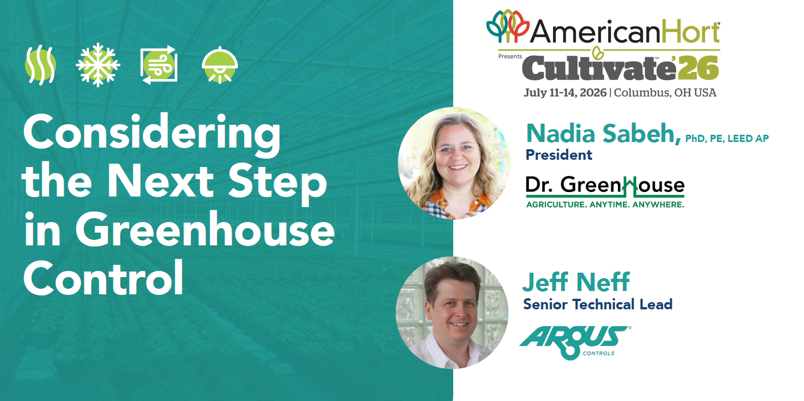
About the Speakers
- Jeff Neff, Senior Technical Lead, Argus Controls brings more than three decades of experience helping growers optimize climate, irrigation, and environmental control strategies. Having supported greenhouse operations since the early 1990s, Jeff now plays a key role in the development of Argus Axia, bringing practical, grower-driven insights into the next generation of control technology.
- Dr. Nadia Sabeh, President, Dr. Greenhouse is a recognized controlled environment agriculture (CEA) expert who works closely with growers to improve greenhouse performance, technology adoption, and operational efficiency.
Choose a System Designed for Growing
Greenhouse control systems have evolved far beyond simple climate management tools. Today, they serve as the operational backbone of modern growing facilities, integrating climate control, irrigation, fertigation, lighting, alarms, and equipment management into a unified platform.
As growers expand facilities, add new technologies, and operate across multiple sites, selecting the right control system becomes less about addressing immediate needs and more about creating a foundation that can support long-term growth and adaptability.
The first consideration when evaluating a control platform is whether it was specifically designed for greenhouse and controlled environment agriculture applications.
Unlike generic building automation systems, greenhouse controls must account for the complex interactions between environmental conditions, crop requirements, irrigation strategies, and production goals. A successful platform should manage all core greenhouse functions while providing a single view of operations.
Key capabilities include:
- Climate control
- Irrigation and fertigation management
- Environmental monitoring
- Alarm management
- Equipment control
- Expansion capabilities
A fragmented collection of independent systems can increase operating costs, create additional management complexity, and reduce operational visibility.
Integration Matters More Than Features
Many control systems can perform basic greenhouse functions. The real differentiator is how effectively those functions work together.
As facilities adopt additional technologies, it becomes increasingly important that lighting, irrigation, climate control, and environmental monitoring operate within a single platform rather than as separate systems. Integrated controls simplify management, reduce duplication, and provide a more complete understanding of facility performance.
Rather than evaluating features in isolation, growers should consider how well a system coordinates all aspects of the growing environment.
Flexibility Drives Long-Term Success
No single control platform is ideally suited for every crop, facility type, or production strategy.
Different systems excel in different segments, from ornamental production and propagation to vegetable production and vertical farming. The more important consideration is flexibility: the ability to adapt to changing operational requirements, new technologies, and future expansion plans.
A control system should not only meet today's needs but also accommodate tomorrow's opportunities.
Plan for Growth from the Beginning
Many greenhouse projects today involve expansions, renovations, or phased growth rather than entirely new facilities.
As operations grow, additional zones, equipment, and facilities place greater demands on the control platform. Growers should ensure their system can scale without creating separate, disconnected control environments. Important considerations include:
Facility Expansion
- Additional growing zones
- New environmental systems
- Increased operational complexity
Multi-Site Operations
- Monitoring multiple locations
- Centralized management
- Consistent visibility across facilities
- The ability to maintain a unified operational view becomes increasingly valuable as businesses grow
Avoid Future Constraints
Retrofits often introduce technologies that were never part of the original greenhouse design, such as advanced HVAC systems, dehumidification equipment, supplemental lighting, and expanded sensing networks.
Supporting these additions requires more than software flexibility. Growers should also plan for:
- Spare control inputs and outputs
- Physical space for expansion hardware
- Adequate electrical service capacity
- Future power requirements
Building expansion capacity into the original design helps avoid costly limitations and upgrades later.
Conclusion
The most effective greenhouse control systems are not simply automation tools. They are long-term operational platforms that help growers improve efficiency, maintain consistency, and support future growth.
The strongest solutions share common characteristics: they are designed specifically for growing environments, unify critical greenhouse functions, scale with the business, and preserve flexibility for future expansion. The goal is not merely to control today's greenhouse, but to ensure the operation remains ready for tomorrow's opportunities.